

At 5:21 PM Eastern time on Friday the 12th of June 2026, an email arrived at the offices of Anthropic from the Bureau of Industry and Security at the United States Department of Commerce. By the standards of administrative correspondence it was not a long message. It directed the company, under the authority of the export control regulations, to suspend with immediate effect all access to its most capable artificial intelligence models — Claude Fable 5 and Claude Mythos 5 — by any person who was not a citizen or lawful permanent resident of the United States. The instruction did not distinguish between persons inside and outside the country. It did not distinguish between persons employed by Anthropic and persons unaffiliated with it. It did not distinguish between the company’s customers and its own staff. The Bureau gave the company hours to comply.
There is a particular strangeness to the action described in that paragraph that is worth pausing on before any analysis of it. Anthropic is an American company. It was founded in San Francisco in 2021 by alumni of a prior American artificial intelligence laboratory, funded principally by American venture capital, and operating under American law. Some meaningful fraction of its research staff is, like much of the technical talent in the modern American economy, made up of people who were not born in the United States but who live and work there under visas the same federal government issued them. On Friday evening at 5:21 PM, the federal government instructed Anthropic to deny those of its own employees, on the basis of their nationality, access to the technology those employees were in many cases responsible for building. The company complied within hours, because the legal alternative was to be in violation of an administrative directive whose technical scope and legal foundation had not been tested in any court.
The question this essay is concerned with is not whether the directive was correct, or whether it was legally sustainable, or whether the technical rationale Commerce offered for it withstands serious scrutiny. The legal and technical questions will be argued and re-argued over a timescale measured in years, by people far more qualified to argue them than I am. The question this essay is concerned with is what the directive is — what kind of instrument is being deployed, against what kind of object, by what kind of state. The instrument, the object, and the state are all, on close inspection, slightly stranger than they first appear. They are also, considered against the longer history of how strategically important infrastructure has been governed in the United States, the latest and most acute instance of a pattern that goes back to the publication of a slim volume on the motive power of fire in 1824.
The directive that arrived at Anthropic on Friday evening is the latest instance of a pattern that has played out, in slightly different forms, every time a physics insight has produced a piece of infrastructure that no single state or company could afford to ignore. The pattern has four conventional acts and one disruptive one, which we will go through in order, because the moment we are living through cannot be read except against the cases that preceded it.
The first act began in Paris in 1824, with a young military engineer named Sadi Carnot publishing a slim volume titled Réflexions sur la puissance motrice du feu, describing the physics of engines. This wasn’t the invention of the engine. Newcomen’s atmospheric engine had been in use for over a century, and Watt’s improvements were already powering British factories; what no one had yet understood was why a heat engine worked or what set the limits on how well it could be made to work. Carnot revealed the underlying structure: a heat engine is a device that exploits a temperature difference, and its maximum efficiency depends only on the temperatures of its reservoirs. Two physicists, Rudolf Clausius and Ludwig Boltzmann, formalised the rest of the theory over the following decades, culminating in the second law of thermodynamics. Once written down, that law let engineers optimise rather than tinker, and the consequences arrived with a lag that now seems characteristic of slow-burning infrastructure revolutions. Railroads, steamships, and factories reshaped the geography of trade. American railways received vast land grants and exercised eminent domain, then consolidated into monopolies that set prices, controlled market access, and corrupted state legislatures so thoroughly that the Pennsylvania Railroad was, for several decades, half-jokingly called the standard legislature of Pennsylvania. Roughly a third of American rail mileage went through bankruptcy at one point or another, but the track survived while the capital structures did not. Washington’s response, after several decades of escalating public pressure, was the Interstate Commerce Commission of 1887: the first federal regulatory agency, and a deliberate refusal of the European nationalisation model in favour of private ownership constrained by public oversight. From the publication of Carnot’s pamphlet to the founding of the ICC, roughly sixty years.
The second act began with Michael Faraday’s demonstration of electromagnetic induction in 1831 and reached its theoretical climax with Maxwell’s unification of electricity and magnetism in the 1860s. The engineering followed in the usual lagged fashion. Edison’s Pearl Street Station opened in 1882; Westinghouse and Tesla’s alternating-current architecture defeated the direct-current camp by the end of the century; the American grid was a recognisable national infrastructure by the 1920s. Samuel Insull, who began his career as Edison’s personal secretary, assembled a utility empire across thirty-two states by exploiting the natural-monopoly economics of electricity distribution — high fixed costs, low marginal costs, and the increasing returns to scale that make competition in a wires-and-substations business structurally implausible. When Insull’s holding company collapsed in the Depression, the lights stayed on. The infrastructure was decoupled from the financial vehicle that had built it, and the response from Washington was once again a regulatory hybrid rather than nationalisation: state-level public utility commissions, the Federal Power Act of 1935, the Public Utility Holding Company Act later the same year. Electricity was, in the formal legal language of the period, affected with a public interest, which is to say that even where the wires were privately owned, the rates at which current flowed through them were a matter for the public to decide. From Maxwell to the Federal Power Act, about seventy years.
The third act is the longest and most consequential, and its political phase is still in progress. The physics began with Planck in 1900 and reached something like maturity in the late 1920s with the work of Heisenberg, Schrödinger, and Dirac. The engineering had to wait for materials science to catch up, and arrived in December 1947 when Bardeen, Brattain, and Shockley at Bell Labs demonstrated the first working transistor, a device whose operation cannot be understood without quantum theory, because band gaps and doping and the behaviour of charge carriers across p-n junctions are not classical phenomena. The integrated circuit followed in 1958, the microprocessor in 1971, the personal computer through the late 1970s, and the internet emerged from a defence research network into civilian life across the 1990s. The companies that came to dominate the resulting infrastructure are the most valuable in human history, and the natural monopolies they enjoy run on a different physics — platform economics, network effects, data flywheels, switching costs, ecosystem lock-in — but the political result is recognisably the same as the railroad and utility cases. A small number of entities control the bottlenecks through which economic activity must pass, and the state’s response is still unfolding: antitrust actions in the United States and Europe, the EU’s Digital Markets Act, semiconductor export controls against China beginning in 2022, the CHIPS Act later the same year as the utility-and-subsidy hybrid extended to a strategic input. From the transistor to serious platform regulation, roughly sixty years. From the deeper quantum foundations, closer to eighty.
The fourth act broke the pattern, and broke it in the way the 5:21 PM email on Friday now rhymes against.
The relevant physics emerged in late 1938, when Otto Hahn and Fritz Strassmann observed that bombarding uranium with neutrons produced barium, and Lise Meitner — working in exile in Sweden, having fled Nazi Germany earlier that year — recognised on a winter walk in Kungälv that what they had found was nuclear fission. Within months, the chain-reaction possibility had been worked out independently in several laboratories, and within four years the United States government was operating a project so large that it required the construction of entire secret cities. Oak Ridge alone consumed more electricity at peak than Canada. The gaseous diffusion plant there was, for some time, the largest building in the world. The plutonium reactors at Hanford and the laboratory at Los Alamos were of comparable scale. The first weapon was detonated at Trinity in July 1945, less than seven years after Meitner’s calculation.
The political infrastructure to govern this physics did not lag the engineering. It preceded it. The Manhattan Project itself was the regulatory hybrid in its purest form: wartime authority directly conscripting the American physics elite, building the industrial substrate in secret with public money, and producing an output that was never permitted to enter civilian commerce at all. The Atomic Energy Commission, established by the McMahon Act in 1946, formalised what the war had already settled. Nuclear technology would be a state monopoly from the beginning, with carefully delimited zones of civilian use authorised under federal licence. There was no private nuclear empire to negotiate with. There was no Insull or Pennsylvania Railroad of fission. The state arrived while the physics was still nascent, and the question of who would govern the infrastructure never really had to be asked, because the answer had been decided in 1942.
The reason this case is worth pausing over is that it offers the only previous example of the lag between foundational physics and regulatory confrontation collapsing to zero. Every other infrastructure revolution gave the state somewhere between sixty and eighty years to figure out how to live with the engine the physicists had built. Nuclear gave it less than seven, and the result was not a hybrid in the railroad sense but something closer to expropriation at birth. The state recognised, accurately and quickly, that an unregulated private nuclear industry was politically intolerable, and acted before the private industry existed.
That is the case Friday at 5:21 PM rhymes with, not the case of the ICC or the Federal Power Act. The AI directive is not a late-arriving regulator trying to catch up with a mature private industry. It is a state attempting to govern an infrastructure while the underlying technology is still being invented, in real time, by companies that are themselves less than a decade old. Whether this can actually be done, whether the nuclear precedent generalises or whether the conditions that made the Manhattan Project possible are uniquely absent in 2026, is the question the rest of this essay turns on. The answer depends on the physics that AI is built from, which is, perhaps surprisingly, the oldest of any of the four cases we have walked through.
The oldest physics
The physics that underlies the directive of Friday at 5:21 PM was given its name by a man who almost never left New Haven, Connecticut. Josiah Willard Gibbs spent his entire working life as a professor of mathematical physics at Yale, taught his first decade in that role without a salary because the chair had not yet been endowed, and produced — in near-isolation from the European scientific community whose admiration he eventually commanded — the formulation of thermodynamics on which the rest of the field still rests. He coined the term statistical mechanics in 1884. Einstein, who was not in the habit of overstatement, called him the greatest mind in American history. The Royal Society awarded him the Copley Medal in 1901, then considered the highest honour in international science. He died at home in New Haven on the 28th of April 1903, at the age of sixty-four, in the same year the Pennsylvania Railroad was at the peak of its political power and the standard legislature of Pennsylvania was getting on with its other business.
To understand why a quiet Yale academic matters to a Friday-evening export-control directive a hundred and twenty-three years later, it is worth walking backward through the structure he was naming, because the structure he was naming transcends physics — quantum and classical alike — all of information theory, and perhaps consciousness itself.
The physics Gibbs was synthesising began in Vienna in the 1870s with Ludwig Boltzmann, who was trying to answer a question that sounds unremarkable now and was considered borderline disreputable then: how can you describe a system that contains so many particles that you cannot, even in principle, track them all? A litre of air contains roughly 1025 molecules, each colliding with its neighbours roughly ten billion times a second. Newton’s equations apply to each of them individually, but the resulting system of equations is unintegrable in any practical sense, and the physical quantities we actually observe — temperature, pressure, entropy — are not properties of any single molecule. Boltzmann’s answer was to abandon the project of tracking individuals and instead describe the system by a probability distribution over its possible microscopic states. The state we actually see, at equilibrium, is the one that the largest possible number of microscopic configurations would produce, and the right distribution is the one that maximises a quantity Boltzmann wrote as
S = k log W
where W counts the number of microstates consistent with a given macroscopic description. The equation is carved on his tombstone in Vienna. It was put there a generation after his death, by colleagues who had spent their careers defending it. Boltzmann himself died by suicide at sixty-two, in a hotel near Trieste in 1906, three years after Gibbs’s death and at a moment when the experimental confirmation of his theory was beginning to arrive in the work of Einstein, Perrin, and others. The physics community he had fought all his life accepted his framework definitively within a decade of his death.
Gibbs’s contribution, developed in parallel with Boltzmann’s and substantially in correspondence with Maxwell, was to recognise that the right way to think about Boltzmann’s distributions was not as descriptions of any single physical system but as descriptions of ensembles — vast collections of imagined replicas, each in a different microstate, with the macroscopic observables we actually measure recovered as averages across the ensemble. From this reframing he derived the entire equilibrium thermodynamic formalism, including a single quantity called the partition function which compresses the whole structure of equilibrium thermodynamics into one line and from which every observable can be recovered: pressure, entropy, free energy, heat capacity. And from it, Gibbs derived an expression for the entropy of a probability distribution:
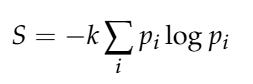
The sum is over microstates; pi is the probability of state i. This is the equation Claude Shannon would write down forty-five years later, in 1948, at Bell Telephone Laboratories, to measure the information content of a message arriving down a wire. The story, which is probably apocryphal but is told widely enough by people in a position to know that it has the texture of truth, is that Shannon asked John von Neumann what to call the quantity. Von Neumann is said to have replied that he should call it entropy, for two reasons: first, the equation was the same; second, no one really understood what entropy was, and this would give Shannon the advantage in every argument.
The substitution was not metaphorical. Shannon recognised — and this is the move that turns Gibbs’s work from nineteenth-century gas theory into the genesis of twentieth-century information science — that what Gibbs had written down for the microstates of a physical system was true for any probability distribution at all. The distribution might be over molecular configurations or over the symbols arriving down a telegraph wire or, eventually, over the next possible word in a sentence. The mathematics is indifferent. The entropy is a property of the distribution, not of what the distribution is over.
This indifference is the move on which the modern machine-learning stack rests, and the lineage is not by analogy.
Consider the operation that every modern language model performs to choose its next token. The model produces, for each candidate token in its vocabulary, a real number called a logit, which we may write as zi. To convert these logits into probabilities, the model applies the softmax function:
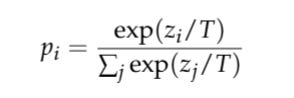
The numerator is the exponentiated logit; the denominator is a sum over all candidate tokens; T is a temperature parameter that practitioners adjust to make the distribution sharper or flatter. The reader who has followed the previous paragraphs has already noticed what this equation is. The denominator — a sum of exponentials over all possible outcomes, what physicists call a partition function — is doing the same work it did for Gibbs’s gas at equilibrium. The logits are negative energies. The temperature is temperature. The dimensions differ — the softmax temperature is unitless where Gibbs’s was measured in kelvin — but the mathematical role is identical. The probability that a frontier model assigns to its next token is, mathematically and not by analogy, the Boltzmann distribution that Gibbs and Boltzmann wrote down for the microstates of a gas at thermal equilibrium.
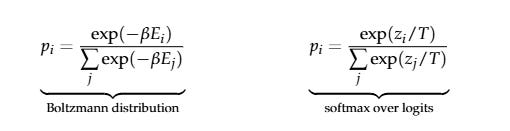
This is not a curiosity confined to the output layer. The training of these models, by stochastic gradient descent on a cross-entropy loss, is the minimisation of the Kullback–Leibler divergence between the model’s distribution and the data’s — which, for the energy-based formulation of these models, is the same minimisation that drives a physical system toward its free-energy minimum. The first neural network architecture to be designed explicitly as a statistical-mechanical system was John Hopfield’s, in a 1982 paper that constructed associative memory as the search for energy minima on an Ising spin glass; Boltzmann machines, developed shortly after by Geoffrey Hinton and collaborators, are named for Boltzmann because the units in them are sampled from Boltzmann distributions. In October 2024 the Royal Swedish Academy of Sciences awarded the Nobel Prize in Physics jointly to Hopfield and Hinton, citing the connection between statistical mechanics and the neural networks that underlie modern artificial intelligence in terms direct enough that the lineage no longer requires defending. The physics establishment has ratified the claim.
What this means is that the physics underlying the current wave of infrastructure is not a theory of any particular kind of stuff, in the way thermodynamics is a theory of heat or electromagnetism a theory of fields. It is a theory of how probability distributions behave under optimisation, and it applies wherever you are forced to reason about a system whose details you cannot fully see. Gas molecules, magnetic spins, neurons in a Hopfield net, tokens in a context window — the mathematics is indifferent. This is the sense in which statistical mechanics is a deeper physics than the ones that preceded it: not in any contestable sense of fundamentality, but in the precise sense that it is transcendent (subfield-independent). The infrastructure built from it is, in principle, universal. It does not specialise to a domain the way railways specialise to freight or grids to electrons.
There is a tidy way of saying this. The natural measure of a theory’s depth is the surprise it makes routine. By that measure, the physics on which the current empire rests is among the deepest we have, because the regularities it makes intelligible — the emergence of macroscopic order from microscopic chaos, the recoverability of distributions from their samples, the convergence of learning processes on landscapes no human can visualise — are the ones that, before Gibbs and Boltzmann named the framework, no one had any business expecting to be regular at all.
Suppose, for a moment, that the United States government decided on Monday morning to build a frontier model itself.
This is not a fanciful exercise. It is the question every previous infrastructure cycle implicitly answered before negotiating with the private empires that built the engines. The Transcontinental Railroad was subsidised, routed, and partially directed by the federal government, which had granted the land it ran across and could, in principle, have built and operated the line itself; the choice to let private capital do it was a choice among available options. The Tennessee Valley Authority and the Bonneville Power Administration are still, ninety years later, operating publicly-owned grids across regions of the country that the private utility industry of the 1930s had either failed to electrify or had electrified at rates the Roosevelt administration considered extortionate. ARPANET, the network from which the modern internet grew, was a Defense Department research project, built by government contractors under government direction, with the technical decisions made by a small group of academic computer scientists whose work was directly federally funded. In every previous case, the implicit threat behind every regulatory negotiation was the same: we could do this ourselves if you make us. The threat did not always have to be issued explicitly. It did not always have to be carried out. But it was credible, and its credibility was what gave the state’s hand at the negotiating table any real weight.
So suppose the directive of Friday at 5:21 PM had been the opening move of a different strategy. Suppose the administration decided that rather than restricting access to private frontier models it would build its own. Where does the project begin?
It begins, presumably, with a director, a brief, a budget, and the authority to assemble a team. The budget is not the problem; a serious frontier model training run currently costs in the low hundreds of millions of dollars, and the federal government routinely spends substantially more than that on weapons systems whose strategic importance is, frankly, lower. The hardware is not the problem either. The compute required is purchasable on the open market, from a small number of suppliers, all of whom would be delighted to sell to the federal government in volume. So far the gedankenexperiment proceeds.
The director’s first task is to hire researchers. This is where it begins to break down.
In the 1940s, the most important physics on Earth was being done inside a federal project, and the people who knew anything about physics went where the work was. The state’s gravitational pull on talent in that period was not a function of the state being a better employer in any abstract sense; it was a function of the state running the project that mattered most, at a moment when the alternative to working on it was working on something else in a country at war. The federal research apparatus that exists today retains very able people in its national laboratories and its newer institutions, and the question is not their capability. The question is where the centre of gravity of the field happens to sit. In 2026 the centre of gravity of frontier artificial intelligence sits at five or six private laboratories, and the people who could plausibly lead a project of this kind are already there, drawn by compensation packages that run from roughly one million dollars a year at the bottom of the scale to figures north of ten million at the top, by the speed at which the work moves, and by the gravitational fact that this is where the work is. A senior researcher at a national laboratory, employed at the highest civil-service grade available, earns somewhat over two hundred thousand dollars. The gap is not narrowable through ordinary administrative measures, and the conditions that closed an equivalent gap in 1942 are not on offer in 2026. The researchers can simply decline, and they would.
Suppose, against all this, that the director somehow assembles a team. The next problem is what to tell them to do. The Manhattan Project’s brief was concrete: produce a device that achieves a supercritical chain reaction. Success or failure was binary and measurable, and the engineering, however difficult, had a stable target. A frontier model has no such specification. The product is a moving target whose definition is set in part by what competitors are shipping, what users are asking for, and what architectural experiments happen to work in any given quarter. Building one is less like building a bomb than like building a better car company. It requires continuous deployment, continuous evaluation against rivals, continuous re-architecting in response to new ideas, and continuous interaction with the millions of users whose feedback shapes the next training run. None of this maps cleanly onto government procurement.
And procurement is the final problem, because procurement is what governs the cadence. Frontier laboratories ship new models on monthly cycles, and the cadence is accelerating. Government procurement runs on multi-year timescales, with compliance gates at every stage that exist for reasons that are individually defensible and collectively crippling. Federal contracting is, by design, slow, accountable, auditable, and proceduralised. Frontier model development is, by necessity, fast, opinionated, experimentally promiscuous, and willing to tolerate expensive failure as the cost of finding what works. The two operating modes are not merely adjacent; they are fundamentally incompatible.
Underneath the four problems lies the deeper one, which is that the model is the residue of the organisation that produced it. Flat hierarchies, rapid experimentation, tolerance for failure, the willingness to discard months of work when a new idea proves out, the capacity to maintain a coherent culture across hundreds of unusually capable people with strong opinions — these are not incidental features of frontier labs. They are the capability. Government can hire excellent researchers; what it cannot do, under current conditions, is replicate the organisational form that produces frontier models. The form is the technology.
Honesty requires a qualification. The argument is structural, not metaphysical. None of these conditions is permanent. A serious wartime mobilisation could conscript researchers and override the pay structure; a coordinated national effort at Apollo scale could establish a parallel procurement regime; a sufficient external shock — a great-power conflict, an economic restructuring of a kind that has historically required either war or depression — could alter the political calculus enough that the four conditions become meetable. The claim is not that the state can never build a frontier model. The claim is that under the conditions that actually exist in 2026, the state cannot, and that there is no peacetime path from here to the conditions under which it could.
There is an obvious objection. When Anthropic refused the Pentagon’s terms in February, the Pentagon did not find itself without recourse: within hours, a competing laboratory had signed the agreement Anthropic had declined, and the state had its frontier-model contract. The threat to build was indeed empty, but the threat to switch suppliers was not, and you are entitled to ask why the distinction matters. The answer is that the two capabilities are not the same capability. A general-purpose model adequate for intelligence analysis and operational planning is available from more than one vendor; the specific, restricted, vulnerability-finding capability that the state now depends upon is, at the time of writing, held by one of them. This is why the transition announced in February has been announced rather than completed, why the six-month phase-out window opened before any court had ruled on whether the designation was even lawful, and why the same administration that branded the company an adversary continues to collaborate with it on the security of the nation’s critical software. The state can replace the commodity. It cannot, yet, replace the frontier. And the part it cannot replace is precisely the part over which the company has asserted the right to set the terms of use.
This is what makes the moment we are living through structurally different from every previous infrastructure confrontation. In 1887 the Pennsylvania Railroad knew, however much it pretended otherwise, that Washington could in principle build a competing line; in 1935 Insull’s holding companies knew that the TVA was already operating; in the 2020s Google and Meta know that the United States built ARPANET and could, if pressed, do something analogous again. Anthropic, in 2026, does not face that implicit threat. Neither does any of the other frontier laboratories. The state’s hand at the negotiating table is no longer backed by the option of doing it itself. The empire was built on a substrate the state cannot reproduce, by an organisational form the state cannot replicate, and the directive of Friday at 5:21 PM was issued by an administration that knows this and is reaching, accordingly, for the only tools it still has.
Three positions that cannot be reconciled
The story does not begin with the export control. It begins nearly four months earlier, on the evening of Friday the 27th of February 2026, when the Pentagon set a deadline of one minute past five o’clock for Anthropic to accept the terms it had been negotiating over for weeks. The terms required the company to set aside the provisions in its acceptable use policy that prohibited the deployment of its models in fully autonomous weapons systems and in the mass surveillance of Americans. The company declined, holding to those two provisions and conceding the rest. Within hours the President directed every federal agency to cease using Anthropic’s technology, with a six-month transition window, and the Secretary of War announced that Anthropic would be designated a supply-chain risk to national security and that no contractor, supplier, or partner doing business with the United States military could conduct any commercial activity with the company. The formal designation letters followed on the third of March. It was the first time the designation, a procurement instrument written under Title 10 to protect military systems from foreign sabotage, had been applied to an American company.
Anthropic was, at the moment of its designation, an American company headquartered in San Francisco, founded by alumni of OpenAI, funded principally by American venture capital, paying American taxes, and operating under American law. Until the end of February its models had been deployed across the Department of War for intelligence analysis, operational planning, and cyber operations; in the summer of 2025 it had become the first frontier-model developer cleared for use on classified networks, under a prototype agreement worth up to two hundred million dollars. An entity that had, the previous summer, been trusted with the most sensitive networks the state operates was, by the first week of March, placed in the category the same state reserves for Huawei, ZTE, and Kaspersky Lab. Nothing about the company had changed in the interval except its refusal of two specific uses.
What followed in the courts did not resolve the contradiction so much as distribute it across two jurisdictions. Anthropic filed suit on the ninth of March, in fact in two courts at once. In the Northern District of California, on the twenty-sixth of March, Judge Rita Lin granted a preliminary injunction blocking both the presidential directive and the supply-chain designation, in a forty-three-page opinion that characterised the government’s action as classic illegal First Amendment retaliation and found it likely contrary to law and arbitrary and capricious besides. She stayed her own order for seven days to allow an emergency appeal. In the separate proceeding, before the Court of Appeals in Washington, the result ran the other way: on the eighth of April a panel declined to grant Anthropic emergency relief against the blacklisting, reasoning that the equities favoured the government. The language the Washington panel used is worth quoting, because it states this essay’s thesis more plainly than the essay can. On one side, the court wrote, was a relatively contained risk of financial harm to a single private company. On the other was the judicial management of how, and through whom, the Department of War secures vital AI technology during an active military conflict. A federal appellate court, asked to weigh a procurement dispute, had described a private company’s product as vital national infrastructure and ruled accordingly.
The same season that produced the supply-chain designation produced something that is difficult to read alongside it. In early April, weeks after being branded a risk to national security, Anthropic launched Project Glasswing, a cybersecurity consortium organised around an unreleased frontier model it called Claude Mythos Preview — a model the company described as too capable to release to the public. The launch cohort was twelve organisations, named publicly: Amazon, Microsoft, and the Linux Foundation among them, with nine others following. The model was not sold; it was deployed under controlled conditions to find vulnerabilities in the software the world’s critical systems run on, many of them flaws that had lain undiscovered in widely used code for one or two decades. The results were not modest. By late May the company reported that it and its partners had identified more than ten thousand high- or critical-severity vulnerabilities; a scan of over a thousand open-source projects flagged some twenty-three thousand potential flaws, of which more than six thousand were judged high or critical, and of a sample independently reviewed, over ninety per cent were confirmed valid. By early June access had been extended to roughly a hundred and fifty further organisations across fifteen countries, including the European Union’s cybersecurity agency and, by the company’s own account, in collaboration with the United States government. The state was among the parties consuming these capabilities even as its own procurement arm had designated the vendor a national-security risk.
The directive of Friday at 5:21 PM was issued against this background. The stated rationale was a jailbreak vulnerability in the Fable 5 and Mythos 5 models, of a kind that Anthropic’s own technical staff characterised in their immediate public response as minor, previously known, and present in essentially equivalent form in every frontier model currently deployed by any other laboratory. The legal instrument was the export control regime, a body of administrative law historically deployed against the transfer of dual-use technology — encryption, missile components, certain semiconductors — to actors of strategic concern. Its application to the licensing of intellectual labour inside a private American company is, on any plain reading, a substantial extension of the regime. The company had to disable access for tens of its own staff within hours of receiving the directive, to ensure compliance with a legal interpretation whose validity had not been tested in any court.
The three formal positions the administration is now holding cannot be reconciled by any consistent legal theory of what the underlying technology is. The supply-chain designation describes a technology that is contaminated and must be excluded from federal use, by the logic under which the same regime excludes equipment from Huawei. The export control directive describes a technology so strategically valuable that its diffusion to foreign nationals, including foreign nationals employed by the company that makes it, must be prevented at hours of notice, by the logic under which the same regime governs enriched uranium and advanced lithography. The Glasswing collaboration describes a technology so operationally indispensable to federal cybersecurity that its capabilities are currently being applied to the protection of the same critical infrastructure the supply-chain designation invokes. The three positions together describe an object that is simultaneously too dangerous to use, too valuable to share, and too useful to abandon. No internally consistent legal theory generates all three.
The way to read this without uncharitableness is the one the preceding argument has already prepared. The administration is reaching with the tools it has, and they were clearly not designed for what it is now asking them to do. The supply-chain statute was written to manage foreign equipment vendors. Export controls were written to manage the diffusion of weapons-grade physical technology across national borders. Neither instrument was built for a strategically critical technology produced inside the country by a private firm whose decisions about its own product are exercises of corporate judgment and, as one federal judge has already held, constitutionally protected speech. The administration is deploying the available instruments past the point at which their stated rationales remain consistent because the political need is real and the instruments available do not fit it cleanly. The contradiction visible in the public record is not a sign of bad faith. It is a sign of strain. The state is governing infrastructure it cannot replicate, using a legal toolkit designed for cases it does not resemble, and the visible result is a set of simultaneous classifications that an honest read cannot reconcile.
Both of the underlying positions, taken separately, are coherent. The administration’s position is that a private company cannot retain veto authority over how a sovereign state uses a technology its own intelligence community has identified as strategically essential. This is the same claim that justified common-carrier obligations on the railroads, interconnection mandates on the telephone networks, and rate regulation on the electrical utilities. Anthropic’s position is that a technology with the capacity to cause grave harm if misused must be operated under safety constraints set by the people who understand it best, and that the engineers inside the system have both the technical knowledge and the institutional standing to set those constraints. This is the same claim that nuclear engineers make about reactor operations and that pharmaceutical scientists make about drug development. Both positions are coherent. Both, in the specific shape they take here, are claims to a kind of sovereignty. The difficulty of the moment is not that one side is wrong. It is that the historical templates for resolving such fights all rest on an option — the state’s residual capacity to build the thing itself — that no longer exists.
The Pennsylvania Railroad ceased to exist as a corporate entity in 1968, when it merged with the New York Central into a holding company that was in receivership within two years. Its track, by then, had carried the freight of an industrial republic for more than a century, and would carry it under other names for several more. Insull’s empire dissolved in 1932 across a sequence of receiverships that ran for years; the houses it had wired stayed lit. The infrastructure outlasts the vehicles that fight over it. This is, in the end, the one thing the long record reliably teaches.
The vehicles fighting over the present infrastructure will dissolve too. The administration that sent the email at 5:21 PM will end on a schedule the Constitution sets and the actuaries can read. The company that received it will be replaced, absorbed, or unrecognisable within a decade. The legal regime under which the directive was issued will be rewritten after litigation that outlasts both. None of this is unusual. None of it disturbs the substrate.
What survives is the physics. The distribution that selects the next token does not care which company is running the model, which agency is regulating it, or which court has ruled what about whose constitutional rights. The mathematics is, as it has always been, indifferent. The infrastructure it makes possible will be there in a hundred years, in the way the rails are still there and the wires are still there, carrying loads the people who fought over them in 1887 and 1935 could not have begun to imagine.
A statistical mechanics describes a system by averaging over the microscopic moves no observer can track, and recovers, in the limit, the macroscopic shape the system was always going to take. The directive of 5:21 PM is one such move. So is the response to it. So is every cabinet meeting, every filing, every conference-room argument that will follow over the next eighteen months. The shape the field will settle into is not yet legible from any of them, and it will not be legible until long after the people writing the briefs have left the room.
A quiet professor died in New Haven in the spring of 1903. The most politically powerful corporation in the country was, in that same season, at the height of its influence; most of the people who ran it, and most of the legislators it owned, would be dead within a generation. The form he had named, without quite knowing what would be built on it, would outlive every one of them. The people who will inherit the infrastructure built on that form — who will run its engines, write its laws, and quarrel over its uses on some Friday evening a century from now — are not yet in any of the rooms where the present argument is being held. They will arrive on their own schedule. And they will inherit, as we always do, the residue of arguments they had no hand in.